English
 Français
 Deutsch
 Italiano
 Español
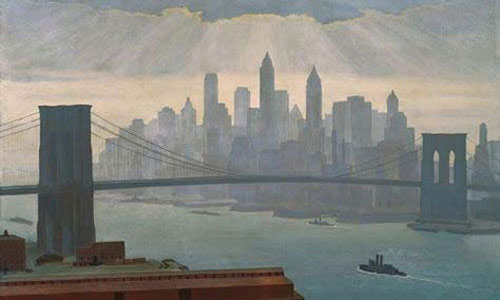
Exhibit from the Phillips Collection in Madrid: Made in the USA
It is not easy to find many characters as dynamic, multifaceted and influential as Duncan Phillips (1886-1966) in the history of American modern art. Referential art critic and collector, Phillips was also the founder and director of The Phillips Collection, based in Washington, which was the first museum of modern art in the United States opening 10 years before the MOMA in New York, did not open its doors until late 1929. From the day the museum opened in 1921, Phillips did not cease expanding. The collection, consisting mostly of works by modern artists, was based on what appealed to his penetrating critical eye. Hence, it constitutes an excellent, extensive and gloriously personal overview of art from the United States from the mid-nineteenth century to the sixties of the twentieth century. Now, the Mapfre Foundation in Madrid (Paseo de Recoletos, 23) will present selections from the collection until January 16, 2011 under the name Made in USA, the first exhibition organized by the Phillips Collection in Europe. It is a unique opportunity to approach a series of extraordinary artists who usually do not enjoy much representation in European museums. Particularly those working prior to World War II are often given short shrift, although after the conclusion of the war the United States became much more prominent in artistic matters. New York replaced Paris as the world art capital and American artists and critics began to dictate the major trends in a process that has only begun to shift back in recent years. The itinerary of the exhibition is divided into ten thematic areas, detailed below, chronologically covering 100 years...
Masaccio´s Trinity in Florence
By all accounts, the Chapel of the Holy Sepulchre in Jerusalem was built in the exact spot where the cross on which Jesus of Nazareth was crucified stood. According to tradition this is where Adam was buried. There is a fresco in Florence whose iconography shows the unusual combination of a Trinity, with which all of its death and decay, could well be a transposition of the sacred shrine. In it, God the Father solemnly oversees the martyrdom of his son from behind the cross, at the foot of which, flanking it, are Mary, whose eyes seem lost in the empty space, and Saint John. The three, Christ, Mary and Saint John, form a triangle whose base is widened by the figures beneath, the principals who commissioned the painting. A skeleton lying on a sarcophagus, inscribed with the memento mori ” I once was what you are and what I am you also will be” occupies the bottom of the fresco. This is the fresco of the Trinity, and was painted around 1425-28 by Masaccio, who died prematurely, poisoned before the age of 30 years. It occupies a space in one of the side walls of the church of Santa Maria Novella, famous above all for the unique polychrome marble facade by Leon Battista Alberti. Santa Maria Novella seems to offer a perfect example of the principles outlined by Alberti´s treatise on architecture exhibiting harmonic drive, and forming a whole in which all parties bear a relationship to each other as is the best music, so balanced that any alteration of any of the aspects would ruin the whole....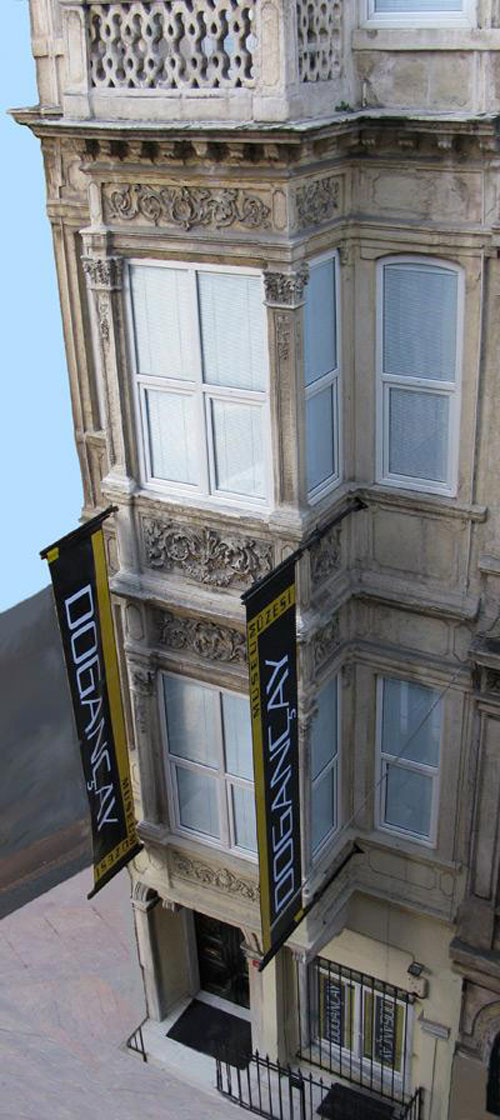
Dogançay Museum in Istanbul
Enrique Vila-Matas illustrates in one of his books a Chinese tale as told by Italo Calvino, about the very skilled artist Chuang Tzu, who was required by the emperor to draw a crab. Chuang Tzu took five years and a house with twelve servants as a necessary condition for the order. Apparently this was not sufficient, when he met the deadline he had not yet undertaken the task. Tzu Chang asked for another 1824 days, and they were granted. Then he drew the most perfect of crabs. In a prose poem by José Angel Valente, the painter and the king are one person, Hui-Tsung, a Chinese emperor who paints “with the skill of an expert in the contemplation of nature,” a quail and a daffodil in the corners as neither a ” a bird or flower can be a center, they are merely a guide for the eye that looks to find the essence of a bird and flower inscribed” With respect to Istanbul, we know thanks to Kemal Bey, a character in one of Orhan Pamuk´s novels, that during the fifties and sixties there was not a single museum where you could see pictures in Istanbul. Fans of painting used to make do with black and white photographs of birds, which they would meticulously illustrate and paint over or use them as models. The photographs could also be of other things, but birds became one of the favorite subjects in Istanbul. They applied their strokes slowly and patiently, with scrupulous attention to detail that, in the eyes of the author of this article, “has some connection to the...
Big Bang Show
Ask any hip cat on the streets of Barcelona about the big bang bar, and they will rave about its cool vintage atmosphere and buzzing Fashion crowd. Although it dates back to the early 90´s, the atmosphere oozes nostalgia. And so does the crowd, their dances, to music on vinyl, marking the rhythms of unselfconscious fun as the bodies of uncertain origins and ages swirl into the vortex of self-referential homage to the past. The papered retro walls, posters and photographs from an unsung ancestral collector, laughter, loud talking, possessed dancing and furtive glances all lend the ample space an animation which speaks of the best of Barcelona nightlife. The Big Bang show, presented as if it were a cabaret, with music and performances, encapsulates the essence of the bar. It is held each Tuesday, with free admission but limited seating, and features new characters presenting everything from poems built around the life of a barman, to emulations of such films as The Wizard of Oz. The show takes place in a small adjoining room at the back of the bar. The presentation is part of the show and it varies every week, sometimes it features actors with music, satire or clowns. The players vary week to week and many offer small humorous monologues on a variety of possible topics. Or other more unusual performances, which features a song that barely sounds at the end, a peculiar Dorothy who walks with a stuffed animal on her shoulder who calls the tin man by her side a bastard for having no heart, dances and music created from videogames … For...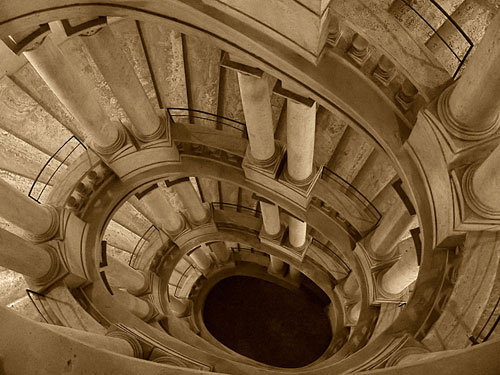
Borromini´s Dancing Plane Geometry
One of the most unique advantages to the traveler who rents apartments in Rome is that it, like the Paris of Hemingway, the city seems infinite… Given the variety of styles and the tremendous quantity and quality of archaeological, architectural and artistic material to behold means that even if one spent every trip just exploring one aspect of the city, one would still never run out of things to see. One particularly intriguing figure, worth a bit of attention, is melancholy architect Francesco Borromini (1599-1667), whose life was cut short, like many a great artist’s, by suicide. This mortal coil has very little place for brilliance, sensitivity and innovation. He was probably one of the most radically theatrical architects Rome had seen, emblematic of a Baroque era defined by the metaphor of World as Theatre. Should you decide to take this route, do not forget to put on your dancing shoes. If, as said by Walter Pater, all art aspires to the condition of music, all the buildings of Borromini seem to aspire to the condition of dance. This article, in turn, aspires to the condition of the monster mash. Perhaps even more appropriate than the metaphor of dance, is the image of the ecstatic dervish found in Rumi´s verses. Just consider the amazing San Carlino alle Quattro Fontane (Via del Quirinale 23), whose ellipsoid forms lead to an altered state of consciousness and reasoned derangement of all senses, and following Rimbaud’s desires convert a mere poet in psychic visionary. Breathe in the dramatic architectural illusionism and bewildering grace as you marvel at the frenzy of the exquisite oval...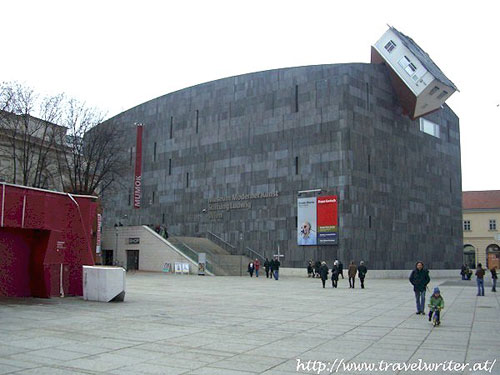
Expo The Moderns at the MUMOK in Vienna
A few months ago, specifically on June 25, a fascinating exhibition opened at the MUMOK, the Museum of Modern Art in Vienna, under the title “The Moderns – Revolutions in Art and Science 1890-1935” which explores the world of modern art in the early twentieth-century inspired and influenced by the revolutionary changes in scientific knowledge during this time. Some of the most important discoveries of the early twentieth century include Albert Einstein’s theory of relativity of and quantum physics investigations by the famous and prestigious Max Planck Institute. These great and revolutionary discoveries significantly influenced the vanguard of modern art. The artistic aspects which clearly and unambiguously reflect these scientific influences include Cubism and Futurism, which form a central part of this fantastic exhibition. Giacomo Balla, Marcel Duchamp, Laszlo Moholy-Nagy, Man Ray and Francis Picabia and many other famous representatives of these movements are included in the exhibition with their most interesting proposals. This unique exhibition was curated by Cathrin Pichler, Martin Guttman and Susanne Neuburger and presents the groundbreaking works juxtaposed with equipment and scientific products of the era, such as x-ray photographs of kinematic models, which highlight the prevailing influence of these innovations in aesthetic paradigms of the avant-garde. This exhibition, as well as showing some of the most important works of the twentieth century, demonstrates quite formidably that the various disciplines such as art and science can inspire and complement each other, and above all, stresses that neither is more valid than the other. Heloise Battista The exhibition runs until January 23, 2011, so you have plenty of time to take a look at this inspiring...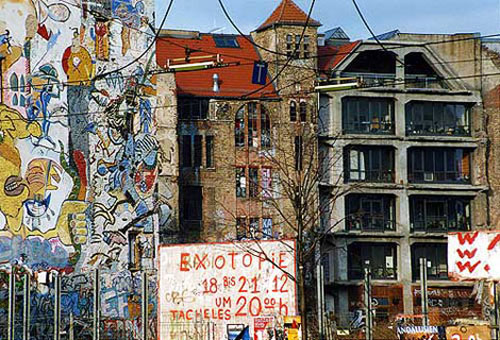
Tacheles: Art Space or Tourist Trap?
Almost all Berlin lovers have been to Tacheles at least once, and no doubt some have wondered how it happened that a building (and a project) which was originally a squat has transcended its anarcho-art punk roots and become a fashionable, guide-book standby of Berlin and helped turn the surrounding neighborhood into one of the hippest in Berlin. The meaning of the word “alternative” has now fade, and lost part of its original connotation of opposition to the established order. Now it seems to have instead become representative of anything that is merely considered “cool.” Tacheles was once a both blueprint and trailblazer of the recovery of urban space and artistic production in the Berlin of the 90s, i.e., just after the fall of the wall. At that time, as we all know, the city experienced an intense period of cultural upheaval, coupled with strong advocacy for new social modes. What is now called Tacheles had formerly been a mall and during the Second World War was used by the Nazis to host the administration and organization of various departments and housed prisoners of war. The building was badly damaged by bombing, but not completely destroyed, and was to be demolished in 1990. In neighborhoods like Mitte, PrenzlauerBerg and Friedrichschain a subculture sprung up promoting autonomy and cultural freedom. Its protagonists decided to occupy this space to promote alternative development. Tacheles, a word which in Hebrew means “revealing” “communicate” or “frank speech” quickly became well known for the atmosphere of the building and the number of projects that were carried out, like performances, concerts, exhibitions of paintings, sculptures, installations....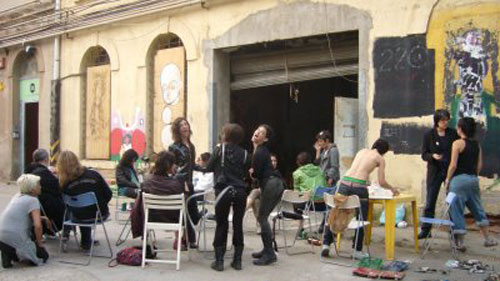
Hangar: Barcelona Artist´s Colony
Everyone, deep down, has dreamed at least once of being an artist. Although money to live on is a daily dilemma for most artists, in recent years we have seen a steady proliferation of scholarships, awards and opportunities of various kinds for emerging artists. One of the most interesting options for emerging artists is to take part in an Artist in Residence program. These residencies are site-dependent and involve experimentation in the arts (including visual arts, music, film, theater, literature, dance and curatorial studies). The centers or institutions where the guest artists stay and work on a specific project allow them to get in contact with industry professionals, and in most cases, allowing the possibility of organizing an exhibition when the stay and the project is completed. Naturally, a cultural capital like Barcelona has a number of interesting options to take a few months to research and workon an art project. One of these residences is Hangar www.hangar.org in Poblenou, an old abandoned factory which has been restored and also runs a production company which offers technical support for artistic creation. Hangar, founded in 1997 by the Association of Visual Artists of Catalonia (AAVC) is a space of 1,800 m2, which is very well equipped. There, they run 15 individual workshops, 2 studios, a media lab, an equipment rental service, and offer technical and advisory production. You can take advantage of their support and technical assistance, training workshops and scholarships for artists in Spain and abroad. You can sign up for Workshops through the annual call, and the studio rent is very accessible. Given the number of options available,...
Psychobilly in Barcelona
Zombies with colored Mohawks or shaved heads, tight jeans, earrings and military boots for boys, and for girls, pin-up makeup, corsets with 50´s hair styles and fuchsia, green, yellow or pink sexy clothes and torn stockings: these are just some of the aesthetic elements associated with psychobilly. This movement it today enjoying a “third wave” of popularity and has one of its major festivals very close to the city of Barcelona, in the city of beaches and palms, Pineda del Mar. Before I tell you about the psychobilly movement in Barcelona and especially the emergence of bands that are playing the scene on the European and international level, here’s a little history on the psychobilly movement. Born in the 80´s and influenced primarily by the band “The Cramps”, the music began to differentiate from rockabilly and punk rock, its main precursors. One of the first bands to become known for this style, “The Meteors,” was born in England in the early 80´s. Over the years the movement grew and other groups like the German “Phantom Rockers” and “Mad Sin” broke on to the scene. These early bands feature a more stylistically pure sound, as from the 90’s on psychobilly began to be influenced by other genres like goth rock, indie, surf rock, etc.. The zombie or monstrous look comes from literary and cultural references, especially horror movies, exploitation flicks from the 50´s, and sci-fi, but its almost always worn with a comic touch. You can see these influences in the clothing and aesthetics of psychobilly cats worldwide. Barcelona is a city with a very productive and entertaining psychobilly movement....