English
 Français
 Deutsch
 Italiano
 Español
Food – Mea(l)ns of Communication
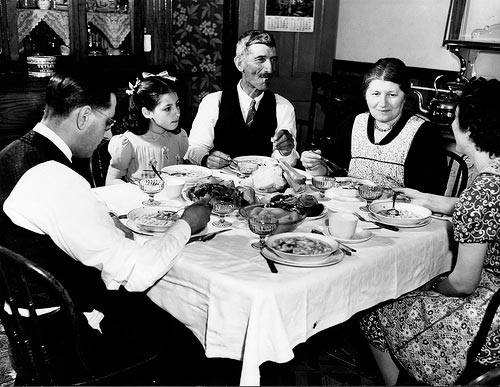
In the Western culture is it considered rude if you talk with your mouth full. However, have you ever sat at the dinner table and it was completely silent? Social gatherings nearly always include food. Having a meal together is a strong tool for our social communication and interaction. In fact, many times it is not just the meal itself that is important, often the preparation that goes into it as well. The popularity of cooking shows on TV support this notion. The exhibition Kochen, essen, redden – satt? (transl. cooking, eating, talking – full?) at the Museum of Communication in Berlin aims to reiterate the powerful role that food and meals have as tools of communication. Displaying historical flashbacks, amusing anecdotes, art, literature work, as well as anthropological analysis of daily rituals and comparisons, the exhibition shows in an interdisciplinary manner how closely knit the bond between cooking, eating and talking is. The exhibition is divided into 5 segments which all focus on different aspects and scenarios of eating: 1. zuhause essen (eating at home) is something that happens everyday in every household and yet it can be so different. From childhood memories to private dinner parties to lonely dinners in front of the TV. 2. draussen essen (eating outside): eating outside at the camp fire is how eating in a group began, but today there’s different reasons for eating outside: no time, no home, love of nature… 3. auswärts essen (eating out): cafeterias, restaurants, snack bars, etc. 4. öffentlich essen (eating publicly): eating to see and be seen. It’s all a matter of image. 5. richtig essen...“Touch and play”: learn to enjoy physical contact
We live in a society and an era in which physical contact between two people has become more infrequent. Locked in our bubbles of personal space, we only give access to the people with whom we are most intimate, which makes it harder for us to understand and master the strong feelings produced by touch. From the healing power of a helping hand resting on our shoulder to the sparks produced by a casual brush of the palm of the hand with someone who attracts us, touch is power. This kind of rigidity and fear which prevents physical contact even extends to many actors, dancers and artists, who in preventing contact forego a powerful tool of communication between them and the public. Trying to avoid this, a group of drama teachers, artists and researchers has established the first festival dedicated to the performance genre “contact improvisation”, in the always artistically vibrant city of Berlin. This event, organized for the first time in May 2010 has been dubbed “Touch and Play Festival” will be an annual event. It is not restricted to actors and performers and is open to anyone who wants to explore the theatrical possibilities and possible artistic expression that can be born out of the physical contact between people. Touch is a phenomenon, a chemical process, and a physical sensation, a journey from the initial fears and misgivings to the sensuality that comes naturally when hormones rage and we are open to our senses. There will be five days of workshops, classes, practical exercises and a closing party (the “Touch & Play Party”) that promises make this...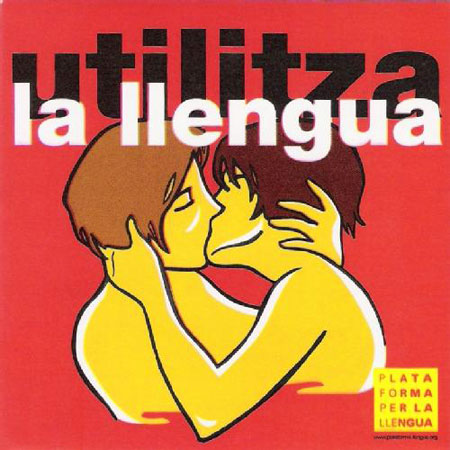
Learn Catalan in Barcelona
Cata-what? Catalan! Though everybody in Barcelona speaks Spanish, it is the capital of Catalonia, where they speak Catalan. There are about 9.2 million speakers. Knowledge of French, Spanish or Italian might help you understanding Catalan, but don’t underestimate the difficulty of this beautiful language! Let’s start with some tongue twisters and you’ll immediately understand: “Setze jutges d´un jutjat mengen fetge d´un penjat.” The j is pronounced like the English [d?] sound in just/large. It is believed that this phrase was used like a watchword during the siege of Barcelona, because it if difficult to pronounce. Or how about this one: “Plou poc, però pa lo poc que plou plou prou.” Note that you pronounce the ou like [ow]. It means: it doesn’t rain much, but it’s enough. A little children’s rhyme to end with: “En Panxo li va dir a en Pinxo: vols que et punxi amb un punxó? I en Pinxo li va dir a en Panxo: punxa´m però a la panxa no.” Another difficult one, but Barça player Xavi Hernandez can help you with this one. The x [t?] is pronounced ‘tsh’ like you would say Cha-cha-cha. So Xavi is pronounced like Chavi. Now you know some of the sounds, it’s time to listen! Rock Catalá is a very popular genre: take a look at the MySpace of the band Toquem Fusta, which means something like ‘knock on wood’, (www.myspace.com/toquemfusta or www.toquemfusta.cat) and discover their new song Abraça´l Fort. After playing in Razzmatazz last February (the biggest disco in Barcelona), your next chance to see them live is at the Andén NºZero 2010 Festival in Salou (end...The Republic of Your Own Backyard: How to Set up Your Own Nation
The Pope has a country of his own, and every week seems to turn up another story of some tiny corner of the world wanting to be independent. We decided that in the interests of self-empowerment, we´d see how to turn your back-yard into an independent nation. First, define the space. One of the criteria of being an independent nation is to have internationally recognised boundaries, so it´s good to start with a detailed map of your back-yard´s fenceline. This will be useful later. Second, you must have a population. If you are the only one living in your back-yard, ask other people to move in with you. If you like, you can do this the way that East Germany did – invite people over for the day and quickly build a very big wall while they´re not looking. Third, you need to organise an economy. Try growing fruit and exporting it to other countries. Selling an apple on the internet might be a good way to do this. Fourth, to be an independent nation, you need to have social engineering. For most countries, this means things like schools and hospitals. If one of your new tenants has kids, ask someone to teach them how to read, or tie their shoelaces, or grow apples. Fifth, you need a transportation system. If your back-yard is very small, put up a sign explaining how to walk. Sixth, you will need something to pay them with. An independent nation has it´s own money. You can draw pictures on pieces of paper, or pay with apples. Defining currency is really only a matter...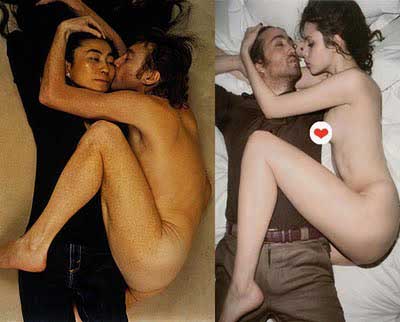
Rock-a-Baby
The children of famous rock stars perhaps belong to one of the most envied species in the world: in addition to being rich, gorgeously blessed with their beautiful model mother’s genes, they embody the glamour of rock, with its air of abandon and rebellion better than anyone else. Born and raised under public scrutiny, it’s not surprising that these enfants terribles have sought to bathe in the glow of the stage lights and the camera lens. They parade down the red carpet, mingle with the most interesting celebrities at the coolest parties, and serve as a nice accessory for every event. They don’t need to prove their place in society or stand out for their merits; their attention and adulation are guaranteed; as illustrated perfectly by the “Paris Hilton phenomenon,” they are the century’s perfect celebrities. Known and loved by millions, for being rich and not for doing much else. However, the name of their famous parents may also be a curse. The son of John Lennon and Yoko Ono, Sean, so far has not been able to remove the label “son.” Despite multiple attempts to establish himself as a musician, this guy stands out for his weakness for pretty girls and his exclusive pedigree. For years we saw him walking hand in hand with the “it” girl of the moment, like the model Irina Lazareanu, or his current squeeze, extra-cute Charlotte Kemp Muhl. The couple has turned a blitz of media coverage from curse to profitable blessing. With their eccentric outfits and nonplussed expressions, they stand strong before any camera that promises to bring more media attention. Apparently,...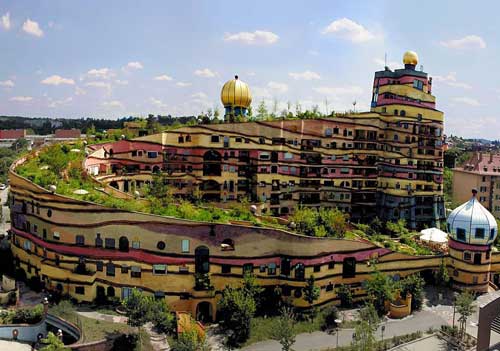
Live Buildings
2010, whether we like it or not, is a year that requires us to re-re-examine our lives: how, what and when we consume, and what can we do to consume less and in a more responsible manner. One of the most inspiring 20th century figures in the fight for a healthier and more aesthetic architecture, both for the earth and for us, was Friedens Reich Hundertwasser, artist-architect-Austrian philosopher. Now, ten years after his death, it is an opportune moment to reconsider his principles, and see if there are ways to incorporate elements of his philosophy into our daily lives to be happier, and do the earth a favour. The right to a window makes life sweeter We have all appreciated the simple pleasure of a breeze caressing our skin on a spring day. One of the most important principles Hundertwasser established with respect to architecture was the right of citizens to a window, which would give light and air, and give tem a space to decorate and enliven as a way to assert their individuality in an urban environment. From an ecological point of view, windows are very important and allow us lower energy consumption while still maintaining the temperature of our homes. The quietest tenant feeds the city, and our view Another very important principle was the incorporation of trees and plants at all levels of urban infrastructure. As stated in his manifestos, we are only guests on earth, so we must beautify and care for it by planting trees and looking for a balance. To plant a tree or have some plants in the window will not...
All About Redheads
Mark Twain was a redhead and he said it best: While the rest of the species are descended from apes, redheads are descended from cats. Love ´em or hate ´em, there is nothing quite like a redhead. Sometimes adored, occasionally feared, these misunderstood creatures are a breed apart. Here´s the skinny on gingers. Everyone´s basic hair pigment is red Yep, if you are one of the crueler types who make fun of our ginger friends, the joke´s on you. From the darkest African hair to the lightest Scandinavian hair, everyone is a redhead to the core. This is why you will occasionally see a brunette man growing a ginger beard. It´s also why a blonde who wants dark hair will need to dye his or her hair red before adding the brown. Redheads handle pain differently to other people Redheads process anaesthetics very quickly. This means that they are more at risk of waking up mid-surgery, are far more quick to wake up after being under general anaesthetic, and often need a higher dosage of local anaesthetic to numb the area. Redheads possess a gene called MC1R, which gives them a much higher pain thresh-hold than others. That means that if you want to hurt a redhead (and live), you better put more force into it than you would with a blonde or a brunette. On the other hand, redheads bruise more easily, so your handiwork will show much faster. Redheads were once burnt at the stake During the witch-hunts, red hair was seen as the mark of the devil, making redheads much more prone to being condemned and...A healing philosopher
“What can be said at all can be said clearly; and whereof one cannot speak thereof one must be silent.” (Tractatus Logico-Philosophicus, 1921) This is probably one of the world´s most famous phrases, cited thousand fold in contemporary philosophy. Its author is Ludwig Wittgenstein, an Austrian philosopher born in Vienna in 1889, who stirred up the field of philosophy with his bold and daring book “Tractatus Logico-Philosophicus” (1921) and is considered to be one of the greatest thinkers of the 20th century. But his thoughts on philosophy didn’t only have great impact on the field. They also had a profound effect on the humanities and social sciences, which is why it is shocking that a consistent and consolidated interpretation of his works has not been produced to date. Nobody has ever really deciphered with absolute certainty the mysterious “Tractatus Logico-Philosophicus” in its entirety. However, we are are certain that Wittgenstein contributed immensely to language philosophy and that he strongly criticized philosophical scepticism, proclaiming that if the sceptics questioned the presence of their own hands, they first had to question language itself, being the real constituent of reality as we perceive it. Consequently, Wittgenstein saw his philosophical investigation as therapeutic work, since he thought he could cure humanity from the evils of conventional philosophical problems and always reiterated that the limits of language itself made it impossible to mention these problems, and thereby, to grasp them. But the fascination revolving around Wittgenstein is not only due to his writings, which give evidence of his passion for knowledge and his genius. His personal diaries and the statements of the people close...
Body Language: What They’re Really Saying
If words only account for ten percent of what we say, where does the other ninety come from? The tone of our voice has a lot to do with it, but by far the biggest communicator we have is our bodies. Unless we are pathological liars, our bodies signal pretty much everything we are feeling. It´s not just the way we stand, it´s our hand gestures, eye movements, everything. The person you´re talking to does it too – and if you know what to look for you, you can spot it. Lying The body is an honest thing, and lying puts it into a state of stress. The heartbeart becomes more rapid, adrenaline floods the system, and the body wants to ´catch´ the lie before it´s out. Kids even cover their mouths when they lie. Lack of eye contact, sudden smoking, scratching the nose or upper lip, looking downwards and away are all signs of lying. Be careful with these though! Any kinds of stress can produce the same results, so if you accuse someone of doing something, they may show all these same signals even if they are innocent. Job interviews are another time that people often look like liars. It´s not just because they´ve padded their Cvs – its just plain old interview stress that makes them look shady. Love Well, not really love. Sexual attraction. In men: There is a difference in men´s body language when they want sex, and when they are attracted to a woman as a potential partner. Men are pretty transparent when it comes to sexual body language: They talk sex, they...