English
 Français
 Deutsch
 Italiano
 Español
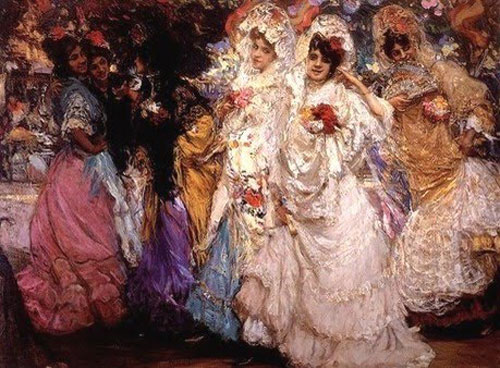
Andalusian Painting at the Museum of Fine Arts in Seville
The Museum of Fine Arts in Seville is putting on an exhibition between the 8th of March and 29th May called “Images & Myths in Andalusian Painting, Bellver Collection,” and will display many of the key Andalusian paintings from 1830-1950. The show, which will be divided into seven different sections, consists of 171 pieces from the Mariano Bellver collection, and will be held in the fifth room of the Seville museum. Though the majority of the artists exhibited are from Seville, there will also be the work of artists from other parts of Spain who have chosen to show their work in Andalusia. One of the sections of the museum is about the arrival of artists to Andalusia from countries such as England and France, who helped to bring about the birth of romantic painting in Spain. Another section, called “Romantic Customs” will include the work of Federico M. Eder, Cabral Bejarano, Domínguez Bécquer and Cortés Aguilar, along with others from the middle of the 19th century. In “Andalusian painters in Italy” – as the name suggests – is the work of José Villegas Cordero and Rafael Senet Pérez. As you journey through the seven sections of the exhibition, you are able to follow the evolution of painting in Andalucia through time, up until the 1950s. More information: http://www.juntadeandalucia.es/cultura/museos/MBASE/index.jsp?redirect=S2_1_3_1.jsp¬icias=1477&novedades=1 Museo de Bellas Artes de Sevilla: Plaza Museo 9, 41001 Sevilla, España MiLK This is a rare exhibition which traces the evolution of art in one of the richest regions of Spain. Don´t miss out on your chance to go along to “Imágenes y mitos en la pintura andaluza. Colección...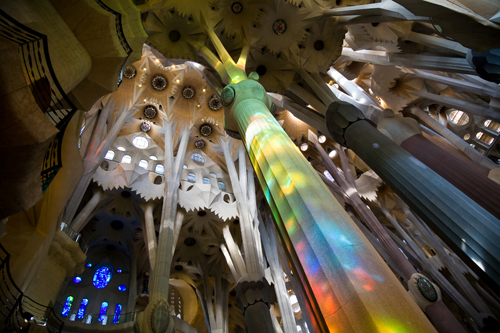
The Sagrada Familia, Architecture award and Urbanism in Barcelona
In a surprising move, back in February the Barcelona council awarded the annual “Premio de Arquitectura y Urbanismo Ciudad de Barcelona” award, which recognises the best construction of the year, to Antoni Gaudi´s Sagrada Familia – or rather, to the project carried out last year – the continuation of the Catalan architect´s plans, which have been deemed impossible for many years. The decision of the jury – presided over Carlos Ferrater, along with Xavier Monteys, Daniel Giralt Miracle, Zaida Muxí and Mónica Gili – has provoked a controversy. For a group of important architects, and various cultural figures and city-dwellers (who have organised a protest), it is inappropriate to consider the Sagrada Familia a building of 2010. Many believe that the decision of the jury was influenced by pressure from the tourist industry, rather than a fair, group decision – and that the public should have had more of a say in the final outcome. Another criticism has been that the granting of the award to the Sagrada Familia is not only an insult to contemporary Barcelona projects, but also that it gives a message of reactionary bias, characterised by the defense of restorative works – a break with the “neos” (“neo-kitsch“) who are in direct opposition to such types of works; such as for instance that of Museo Can Framis de Poble Neu, which was transformed from an old factory to a new public space, and the winner of last year´s award. The committee has been attacked for favouring remodelled buildings, and “imitation” works over projects which work hard at new, innovative use of materials and space –...Museo de la Ciencia
The Museo de la Ciencia (CosmoCaixa) is one of the most famous in Europe and inside you can enjoy an incredible planetarium amongst other exhibitions.
La Pedrera
La Pedrera (or Casa Milà) is a building in Barcelona which is known worldwide whose architect is Gaudí.
Mercado de la Boquería
La Boquería is the big market in Barcelona: it offers food and quality products. It´s a common place where Spanish people and tourists go.
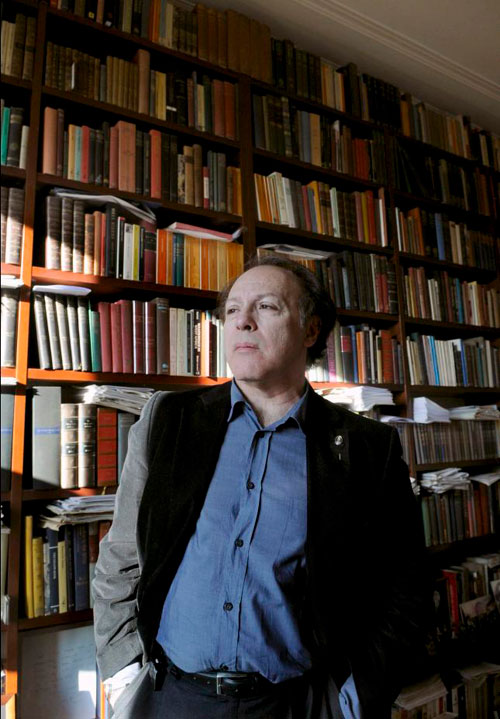
Javier Marías, Austrian Prize for European Literature
According to the legend spread by the writer himself, when he was 17, Javier Marías went to Paris with the intention of spending the summer in a house owned by his uncle, the acclaimed cult director Jesús Franco, to write a totally imagined novel set in America. Taking advantage of the fact that his uncle was out of town, and living off a diet which basically consisted of bread and mustard, Marías developed a specific work discipline. He divided the day into three parts: during the morning, he stayed at the house (which was on 15, Freycinet) and wrote his book, in what he explains as a trance-like state, taking up in a room with a white piano, and cupboards full of erotic magazines. Later, when the cinemas opened, he spent his afternoons going from one movie house to another, having a special preference for the Cinémathèque de Henri Langlois, where he would immerse himself in American films from the 1930s, 40s and 50s – which provided the sole source of inspiration for his novel. Then finally, at night time, he would hang out in the terraces of Champs-Élysées with his guitar, playing covers of Bob Dylan songs in the hope that passers by would take pity and chuck him a few coins. The literary result of this time sojourn in Paris was Los dominios del lobo, a brilliant novel which was a celebrations – of the pleasure of story-telling through a tapestry of different stories, generations and classes. Curiously, since then, Marías´ work has appeared to go increasingly in the opposite direction, and today, he is known throughout...
Final Four in Barcelona: The Big Party in European Basketball
From May6 to May 8 the Final Four will take place at the Palau Sant Jordi in Barcelona. With a capacity of more than 16 000 people this is one of the greatest venues where this fierce competition already took place in 1998 and 2003. The way to the final 4 is long and hard, it begins in the fall at the beginning of the season and goes through different phases where the less strong teams are being eliminated quickly. After the initial league phase where the first four teams of each group qualifies, it goes on to another league of four more reduced groups where the first two qualify. The last 8 make up the quarter finals in which a system of “best of 5” play begins. From there the last 4 result, that will compete for the European cup in the semifinals and finals on one intense weekend. The big surprise this year is that although the competition is held in their city and they were one of the favorites to go all the way, Regal Barcelona, the reigning champion from last year didn’t make it to the Final Four. The got eliminated in the previous round by the Greeks of Panathinaikos. But this was not the only surprise. After having lost by an embarrassing 48 points (89 – 41) in the first game, Montepaschi de Siena ended up winning the next 3 eliminating the mighty Olympiakos. Maccabi Tel Aviv did the same. After starting of 0:1 against Caja Laboral Vitoria, they were able to avoid elimination. However, the Israeli holiday Yom Hazikaron on May 8 (Day...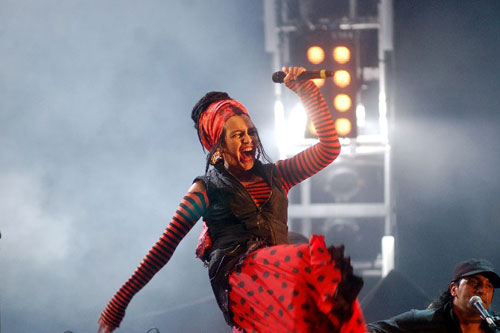
Ojos de Brujo at Apolo
The band Ojos de Brujo will play next Friday May 6 at 21:00 pm at the Sala Apolo in Barcelona, to celebrate ten years on stages worldwide. On this occasion the band will be accompanied by more than 20 artists that will reinterpret all their greatest hits and the huge number of songs produced over the years. Along with celebrating the career of Ojos de Brujo, the concert aims to highlight the group being finalist at the Best Fusion Album in the 2011 Music Awards with her album Corriente Vital-10años. The awards will be on May 18 at the Arteria Coliseum in Madrid. Ojos de Brujo was born in Barcelona in 1996. In those years, Barcelona was experiencing music jam sessions and Ramon Jimenez, who was playing flamenco guitar, met Juanlu, bassist, and they began to give shape to an interesting mixture of sounds with the flavor and passion of flamenco. From a clear notion of what they wanted and what they did not as a musical concept his first album was born, Vengue, edited in Belgium, Germany, Italy and France. Since then they developed a work of collaboration with various musicians, though the group was stabilized by Ramón Jiménez, Juanlu, Marina, Xavi Turull, Panko, Sergio Ramos and Maxwell Wright. In 2002, with the second album, Bari, the group launched an ambitious company creating the seal La Fábrica de Colores to produce their own projects, the most experimental one and focused on social and environmental issues. This second album is going to mean the internationalization of the group with promotional tours around the world. In 2006 their third album...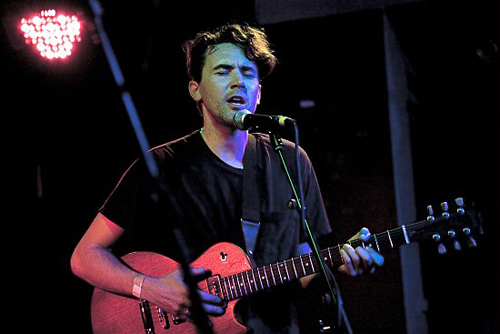
Cass McCombs Concert in Barcelona
Singer/songwriter Cass McCombs will play at the Sala Razzmatazz on May 16. The musician one of the most mysterious artists on the American neo folk scene, rarely gives interviews, because he avoids the media like the devil the water. He never gives interviews over the phone and he doesn’t have a solid residence. According to him, he earned money cleaning toilets in Baltimore and his grandmother was the one who cut the umbilical cord when he was born. Odd but fascinating facts. His „biography“ tells us that he was born in the Bronx, Haiti and Tahiti in 1977, but the reality is that he was born in California. In 2002 he recorded his first album “Not the Way” and in 2003 he dropped “A”, 2005 “Perfection”, 2007 “Dropping Writ” and 2009 “Catacombs.” McCombs is a modern nomad, a troubadour, who travels from city to city to let the change of scenery and freedom inspire him. His songs are proof for his unbelievable talent as well as his genius as writer. His songwriting abilities hint at an unconventional mind, but his music doesn’t at first. Later on, though, you will find something magical in it that will draw you in. On stage McCombs is not the shy person he is in real life. During concerts he puts his all in, his music and his incredible sense of humor. Pale, skinny and fragile in appearance he has the ability to make you laugh, cry or dance. A truly extraordinary singer whose musical influences are The Velvet Underground and Morrissay, but you will surely find a little bit of Dylan and Bowie...