English
 Français
 Deutsch
 Italiano
 Español
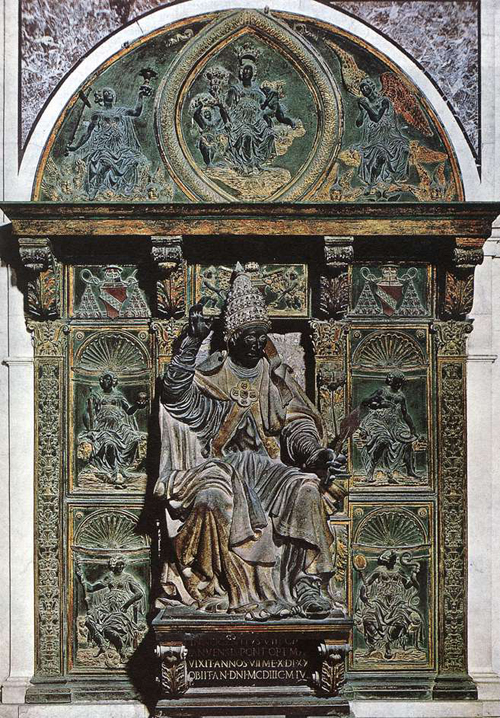
The Tomb of Pope Innocent VIII
History, as we all know, is only the history according to the dictum of the present day. Each society carries out historical investigation according to the prevailing circumstances and interests of the time – it´s this to which history becomes subordinate. Dates and facts are organised and prioritised to create a determined past. Perhaps with this in mind, we shouldn´t immediately dismiss the curious investigation which led to Ruggero Marino (author of Cristóbal Colón: el último de los templarios) and Javier Sierra (La ruta prohibida y otros enigmas de la Historia) suggesting the possibility that Christopher Columbus was in fact a Templar knight, and that he in fact arrived in America for the first time earlier than the famous date (in 1492), with special guidance from the religious Order. According to economist Jacques de Mathieu, some of the knights of the Temple appear to have used and exploited the South American silver mines during the 12th and 13th centuries, having perhaps arrived on the trail of the lost tribes of Israel. This would certainly explain the large amount of templar silver money in Europe around that time, and the fact that the templars established the principle port for their fleet not via the Mediterranean, which would have been the obvious and natural choice, given the context of the period – but the Atlantic, in the Normandy area La Rochelle. A further piece of evidence for this interesting hypothesis might also lie in the left corridor of the basilica of San Pedro in Rome, atop the magnificent tomb of Pope Innocent VIII – who Ruggero Marino argues was Columbus´ true...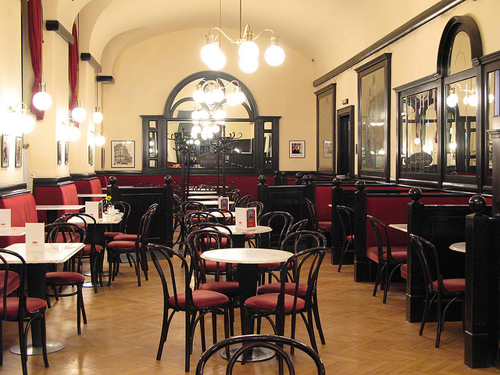
Griensdteil café and Secession pavilion in Vienna
Without reducing the Germans to the condition of blonde, beer drinkers beasts, some day we will have to heed Nietzsche in this aspect too and study the history of societies so inseparable from the history of food and drugs and the environment in which both were and are consumed. We will start, for example, with Vienna around the transition between the nineteenth and twentieth centuries of the Christian era and gauge the significance that the café life had –from which thanks to Stefan Zweig, Joseph Roth, Hermann Broch and Robert Musil we have inhereted an invaluable literary testimony- in the cultural epicenter of the Austro-Hungarian twilight during those bright and ambivalent Belle Epoque years. It’s so much so, that at that time the Viennese café became an institution of a very special class. As it not only was the most crucial axis of social life but also the indisputable center of cultural activity. Thus, the avant-garde artists association Hagenbund, whose formal language came to dominate the artistic activity in Vienna after the Great War, it took its name from Herr Hagen, the owner of the café-restaurant Zum blauen Freihaus, where they met. Another group of artists, the Siebener Club, had its origin in the cafe Sperl, and the militant group of Austrian Artists Association -better known as the Viennese Secession- originated on April 3, 1897 in the Coffee Griensteidl the same way another coffee table six years later was witness of the birth of a group attracted by a more rational and practical aesthetics emerged within Secession itself The Wiener Werkstätte or Viennese Workshops. The original Viennese Secession had...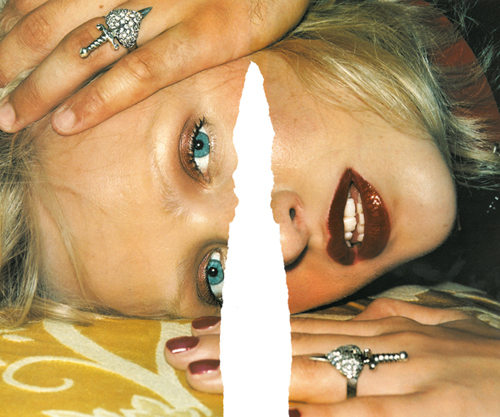
Nico Vascellari: a new exhibition at Rome’s MACRO
Italian artist Nico Vascellari is a master of eccentricity. His incredible installations are a complete mix up of painting, collage, video, performance and sculpture. His main reference points are folklore, nature and the alternative underground scene. Vascellari is one multi-faceted man – as well as being a contemporary artist, he also brings his rebellious spirit to music, singing in punk band “With love.” In 2007, Vascillari participated in Manifesta, one of the most radical, and interesting contemporary art biennales. His contribution – a large scale video installation – caught the eye of curators and art critics from all round the world. That same year, he won the “Young Italian Art Award,” and his work was included in hugely successful corporate art collection The Deutsche Bank Collection. 2007´s “Cuckoo” was one of his most daring projects yet; an installation which fused concepts of the ritual, iconography, rhythm, the church and sacrifice, and involved an impromptu performance by members of his punk band. Now showing at Rome´s contemporary art museum MACRO, Vascillari is one of Italy´s most exciting artists. Back in October of last year, he opened with exhibition “Blonde” a show which inspired by the museum´s curved walls. For more information about “Blonde” go to: http://en.macro.roma.museum/mostre_ed_eventi/mostre/nico_vascellari_blonde Heloise Battista If you´re interested in finding out about one of today´s most interesting emerging artists, rent one of the apartments in Rome and don´t miss out on Vascillari´s new exhibition at Rome´s MACRO, on until the 22nd of May Translated by: Poppy...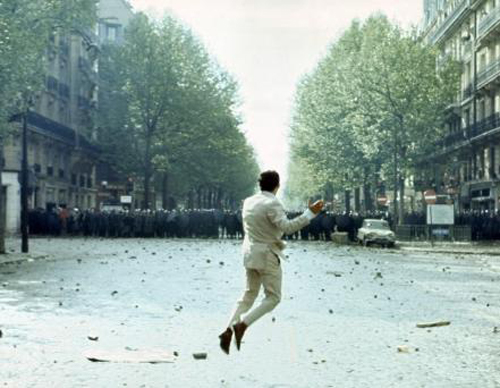
Fears in Paris
In early 1998, as if foreseeing his own death, which occurred just a few months later, the English poet Ted Hughes gave the press a collection of letter-poems written in first person over a period of more than 25 years directed almost entirely to his first wife, American poet Sylvia Plath, who committed suicide 35 years earlier. It´s called Birthday Letters, a book of breathtaking beauty where Hughes first addressed, since the time that perhaps he first saw her in the Strand in London in a group photo of Fulbright Scholars, the question of death and absence of Plath and the tense, beautiful and dramatic life they shared. Through this collection we know that behind his modest wedding in Joycean Bloomsday (June 16, when Ulysses passes) in the parish of St George of the Chimney Sweeps in the district of Holborn in London, on whose altar, where Plath saw “the sky open and show ripe riches to fall on us, Hughes, levitating at her side, saw himself subjected to a strange time: the bewitched future”, both went to a Paris honeymoon. There, while Plath enthusiastically revived the myth of the city that we owe to Stein, Hemingway, Fitzgerald, Miller and other Americans of the Lost Generation, for Hughes, secretly, there was only “the capital / Of the occupation and the old nightmare. / He read each bullet scar on the Quai stones / With a familiar sinister feeling, / And stared at the afflicted way in which the sun exposed the sidewalk / Below…” It isn’t difficult to share the feelings of the English poet when visiting the French...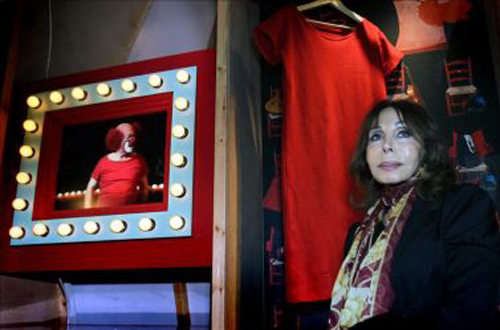
Un siglo de circo: Exhibition at Arts Santa Mónica
The cultural phenomenon of the circus has gradually undergone a resurgence, thanks to the recent recognition of the complexity of the circus arts. Even if circuses have often been seen as places of animal exploitation, this recognition of its aesthetics, and its contribution to fine art is an opportunity to delve a little deeper. Beyond the “cruel” label of the spectacle is a wonderful way of life, whose inhabitants live for their art – an art which forces them to adapt and sacrifice a lot. Itinerant, ephemeral and diverse, the circus troupe traverses the globe – great cities and small villages alike – showcasing it´s joyful, virtuoso world. The big top and all that goes on inside it involves a lot of hard work. The inhabitants of the circus are its creators; tightrope walkers, trapeze artists, jugglers, magicians, clowns – each person has their own special role in the circus micro-community. Circuses are often made up of entire families, and is a lifestyle which is passed down, from generation to generation. Telling these stories – or at least one of them – was the aim of exhibition “Un siglo de circo” (“A century of the circus“), where we learn about Paulina Andreu Rivel, daughter of famous Barcelona-born clown Charlie Rivel.* She may not be as well known as her father, but Paulina Andreu Rivel has had an active career in the circus – on the eve of her 90th birthday – is almost a century old. A collection of photographs tell the story of Paulina Rivel, and the many well-deserved tributes she has received over the years – the...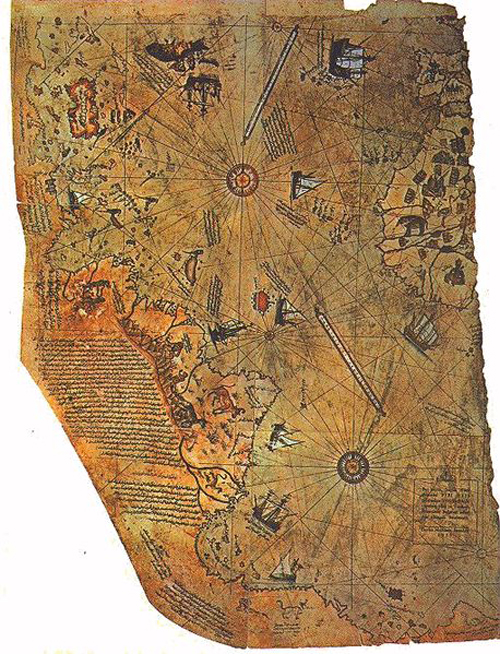
Haci Muhiddin Piri oglu Haci Mehmed’s enigmatic atlas
History is always the present history. A fiction story that must be supported by rigorous methods of experimental science to work (otherwise, we should never forget it, we´re not even talking about history), but belonging by right to the battlefield in the history of ideas, always located, as is well known in the Middle Ages, in a literary region beyond genres. History is produced by tracking values of our time in past periods that have as principal aim to legitimate and pass them off as needed. In this exercise of justification of the present, everything that does not fit is misrepresented, omitted or quieted. Impressed by his massive and heterogeneous nature, when Flaubert visited Istanbul in 1850 he wrote a famous letter in which he predicted that the ancient Constantinople would be the capital of the world a century later. According to Orhan Pamuk, what occurred, therefore, within the prescribed time was that after the fall of the Ottoman Empire, Istanbul had become a city possessed by bitterness, poverty and ruin. Among the ruins of a glorious past there was a magnificent and disturbing world atlas of 1513 during the rule of Atatürk, which, despite being from the first moment it was found out one of the great national treasures of the modern and laic Turkey, whose representation decorates even today the Turkish notes, has since then continued strictly away from public display. Even scholars who want to examine it directly often meet, despite its excellent state of preservation, some insurmountable bureaucratic difficulties. Somehow not surprisingly it is so, as the map in question has a number of questions...
Last Words
Let´s look back at the last words of some of our key cultural figures – such as Beethoven, who from his deathbed, shortly before leaving this world, said “Friends applaud, the comedy is over.” French writer Francois Rabelais´ last words were similar: “Draw the curtain, the farce is over.” Scotsman Alexander Graham Bell, who invented the telephone whilst experimenting with listening devices (his mother and wife were deaf) was brief in his final hours – to his wife´s plea of “don´t leave me,” came the reply “no.” Lord Byron, English poet, spared any detail, deciding to depart as though any other night, with the words “Good night.” Theodore Roosevelt, president of the United States, apparently felt the same way as Byron, simply saying “Turn out the light,” just before he died. On the contrary, German novelist Wolfgang von Goethe felt that it was too dark, exclaiming “Light, more light!” Russian writer Tolstoy´s last words were in the form of a riddle; “Even in the valley of the shadow of death, two and two do not make six.” One person who left in more dramatic style was fellow Russian writer Anton Chekhov. The doctor had barely arrived at an ill Chekhov´s side, when he said “I´m dying.” When the doctor sent orders for an oxygen tank, the writer said “It´s no use, by the time they bring it, I´ll be dead.” So the doctor quickly changed the order to a bottle of champagne instead – which Chekhov accepted, saying “It´s been ages since I drank champagne.” He emptied the glass, retired to bed, and stopped breathing shortly after. Great last...
The Viena Central Post Office
As he writes in the extraordinary and sadly now out of print Summer Dress, it was on the roof of Madrid´s Círculo de Bellas Artes that writer Samoa Albert Hanover first heard the story of Leon Trotsky´s brief visit to the city before going into exile in Mexico. According to the story, the idealogical and revolutionary Russian writer, who was also at the time leader of what might have been the best alternative to the Stalinist regime, was said to be very impressed by the monumental Telecommunications Palace – the central post office which was built over fourteen years, between 1904 and 1918. Transfixed with admiration, he couldn´t help regarding the building as a sacred place, attaching a special significance to its looming towers and antennae. Trotsky´s sensibilities though were not just attracted to Antonio Palacio´s wonderful building, but to the postal service in general. Both literature and real life is full of examples in which the arrival of a letter – not to mention all those letters which never arrive for one reason or another; such as the one Beckett sent aged 29 to Soviet filmmakers Sergéi Einstein and Vsévolod Pudovkin offering himself up as their apprentice, which was lost forever in the midst of a smallpox outbreak – can change forever the course our lives and history. In spite of technological advances, the same theory can be applied to emails, and mobile phone messages; posing the intriguing, existential and above all, literary question – where do all those lost messages go? Perhaps in extreme contrast to Nuestra Señora de Correos de Madrid is the equally magnificent Central...
Jacques Rancière: First International Conference of Aesthetics and Politics in Valencia
Jacques Rancière is an obligatory point of reference for any debate about aesthetics and politics, which is why the Polytechnic University of Valencia, with sponsorship from the Valencia French Institute has organised The First Conference of Aesthetics and Politics (23rd, 24th, and 25th March) around his ideas. Jacques Rancière: First International Conference of Aesthetics and Politics hopes to open up the debate on Rancière´s thoughts, basing itself on the relationship between literature and history. On the 23rd of March at 5.30pm, Rancière will lead the opening conference in the Salón de Actos de la Escuela Superior de Ingeniería Informática at the Polytechnic University of Valencia. For the closing of the event, there will be a round-table debate between Jacques Rancière and other invited speakers. Jacques Rancière was born in French Algeria in 1918. The protegee of French philosopher Louis Althusser, Rancière collaborated, along with Althusser and Ettiene Balibar for the famous book Reading Capital, a work which was highly influential amongst the intellectuals and students involved in May 1968, and which ignited the revolutionary thinking of the time, as it was a guide to reading Karl Marx: The Capital. After May 1968, Rancière parted ways with his mentor in order to concentrate on his search for intellectual freedom, and its possible links with political freedom. A noted work is The Ignorant Schoolmaster, which is based on the experience of a professor called Joseph Jacotot during the 18th century, who claimed “who teaches if to emancipate is to stupefy.” Like Jacotot, Rancière asserts that there is no such thing as different levels of intelligence – that everybody, however simple they...