English
 Français
 Deutsch
 Italiano
 Español


ONLY BE AMSTERDAMMER

ONLY BE BUDAPESTER

ONLY BE VENETIAN

ONLY BE BARCELONIAN

ONLY BE BERLINER

ONLY BE VALENCIAN

ONLY BE ISTANBULITE

ONLY BE FLORENTINE

ONLY BE LISBOETA

ONLY BE LONDONER

ONLY BE NEW YORKER

ONLY BE MADRILENIAN

ONLY BE MALAGUEÑO

ONLY BE MILANESE

ONLY BE PARISIAN

ONLY BE PORTUENSE

ONLY BE PRAGUER

ONLY BE ROMAN

ONLY BE SEVILLIAN

ONLY BE PROXIMAMENTE

ONLY BE ATHENIAN
ONLY BE COMING SOON
ONLY BE COMING SOON
ONLY BE COMING SOON
Last posts
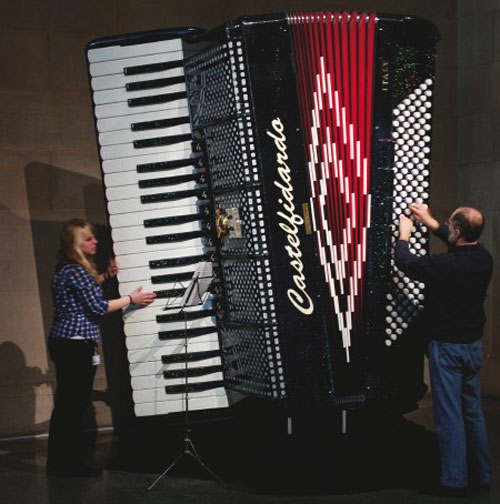
Ruth Ewan in the CAAC in Seville
Up until 16 October the Centro Andaluz de Arte Contemporáneo hosts The Ephemeral Past, an art exhibit by Ruth Ewan. This exhibition forms part of a cycle entitled La Canción como Fuerza Social Transformadora organised by, and held at, the Andalucia-based gallery. This cycle looks at the role played by music and art in social change during the second half of the 20th century. During this period rock music emerged as a symbol of youthful rejection of conservative values. It became a symbol of freedom, protest and resistance. Music brought a change in everyday relationships, aesthetics and literature. The Beatles had a huge influence on male aesthetics, saying nothing of their enormous musical impact with their sophisticated take on rock and roll and skiffle and their pioneering use of psychedelia in pop. The work of British artist Ruth Ewan investigates the social impact of songs, oral traditions and myths in communities. She explores non-hierarchic communication: that which does not go through the usual channels like education or media, but is instead transmitted orally. In The Ephemeral Past Ewan exhibits five pieces that have been shown before: A Jukebox of People Trying to Change the World; Did you kiss the foot that kicked you?; Unrecorded Future Tell Us What Broods There; Fang Sang; and The Cut Wren. However, the exhibition also includes a conceptual work, Six Signs, created by the artist especially for the Centro Andaluz de Arte Contemporáneo. In the piece, Did you kiss the foot that kicked you?, the artist brought together 100 buskers to perform The Ballad of Accounting, a song composed by Ewan MacColl in 1964. MacColl was a... read more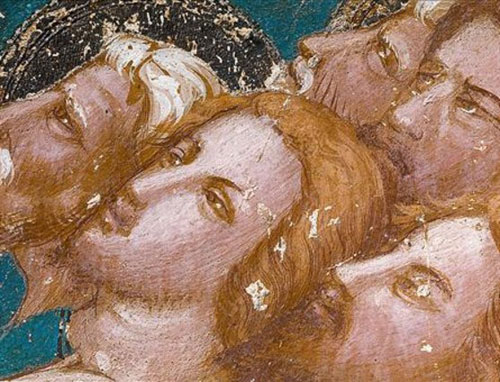
Murals under the magnifying glass at MUHBA in Barcelona
Gothic art, one of the most important in existence in the entire world, was born in Western Europe after the middle ages. The art originated in the north of France, but it soon expanded throughout the entire West. In the most part of Europe, Gothic art developed through many different forms which have today become high icons of art; central places for this include Germany, England and Spain. In counter position to Roman art, which expressed the rural society of peasants and fighters, the gothic represents the cultural development of the sectors of the bourgeoisie, the universities, the religious orders, and other, more revolutionary sections of society. Unlike the small rural churches which had principally displayed Roman art, Gothic art was characterised by incredible, vast constructions, full of light and unique; unmistakably original architecture. Although architecture is the most famous form of this artistic movement, it is not the only one; there are also numerous painting and other Gothic art works. It was in this style that the San Miquel chapel of the Pedralbes monastery was decorated; with mural work appointed in 1346 to Ferrer Bassa, who lived from 1285 until 1348, by abbess Francesca Saportella, for her cell. The works, as anyone immersed in the world of art will know, are closely related to the Franciscan devotion for the passion of the christ, the pleasures of the Virgin, and other saintly figures. The History Museum in Barcelona is presenting an exhibition called “Murales bajo la lupa. Las pinturas de la capilla de San Miquel”, until the 31st January, which is all about Gothic Barcelona, and its many important... read more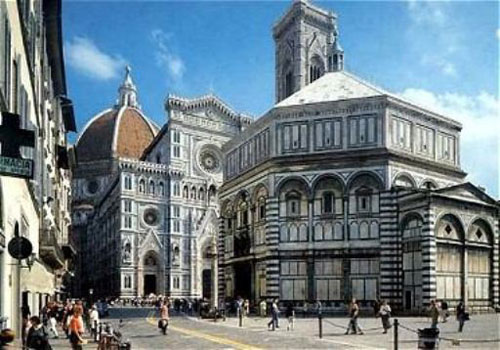
Birth of perspective in the Piazza del Duomo in Florence
In one of the entries of the marvelously penetrative and lucid book of notes, essays, interviews, drawings and description of projects of Bill Viola, ´Reasons for Knocking at an Empty House´. Writings 1973-1994´, the American artist reconstructs the transcendental implications of what probably happened in the Piazza del Duomo in Florence that day in 1425, when Philippo Brunelleschi, creator of the iconic and important Duomo, not yet finished by then, in the Santa Maria dei Fiore Cathedral, stood in front of the doors of this building and installed a small wooden box on a stand, looking at what has become the city´s oldest building, the famous and admirable Battisterio, not yet immortalized by the Doors of Paradise of Ghiberti, located right in front, on the other side of the piazza. Little by little his friends started to come, as well as different groups of people and ´cognoscenti´, an important part of the cream of Florence´s artistic community of that time, who Brunelleschi had previously invited to come by the piazza to check out with one eye (the other one had to be closed) through the small orifice that there was to one side of the box. By moving a lever a mirror came up, that put a small painting of the Battisterio right in front of them, in line and proportional to the first monocular and direct vision of the building which they´d come across before the ´operation´. Regarding the shape and geometry, both visions were hardly differentiable. Viola compares the scene with one of a photograph pioneer who makes a demonstration of how a camera works, because on... read more
RANKINGS
Do you want to know the best cities to escape for gastronomy? We will tell you!

VERSUS
Showdown: pure and simple. Comparison is the best way to make a decision.

TRAVEL TIPS
Travelling means many things. We will provide you with all you need. Don’t miss anything.

APPS AND BOOKS
Technology and literature, the necessities of a good traveler.

GUEST
We want to hear your story; we want to travel with you.
Changes, progress and achievements. Only-apartments daily.
Promotions