English
 Français
 Deutsch
 Italiano
 Español


ONLY BE AMSTERDAMMER

ONLY BE BUDAPESTER

ONLY BE VENETIAN

ONLY BE BARCELONIAN

ONLY BE BERLINER

ONLY BE VALENCIAN

ONLY BE ISTANBULITE

ONLY BE FLORENTINE

ONLY BE LISBOETA

ONLY BE LONDONER

ONLY BE NEW YORKER

ONLY BE MADRILENIAN

ONLY BE MALAGUEÑO

ONLY BE MILANESE

ONLY BE PARISIAN

ONLY BE PORTUENSE

ONLY BE PRAGUER

ONLY BE ROMAN

ONLY BE SEVILLIAN

ONLY BE PROXIMAMENTE

ONLY BE ATHENIAN
ONLY BE COMING SOON
ONLY BE COMING SOON
ONLY BE COMING SOON
Last posts
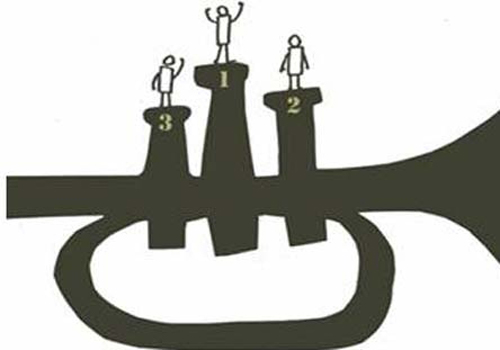
Get Jazzed Up in Barcelona
More than any other music, the good people of Barcelona seem to embrace jazz. Throughout the summer months there is free jazz in the parks, and many a jazz festival passes through the Catalan Capital each year. Most nights of the week there is jazz to be heard somewhere in Barcelona. If you´re in the mood for something soulful, then check out these Barcelona jazz hot spots. JAMBOREE This is the first place to look for live jazz. Jamboree has music 7 nights a week, with a jam session on Mondays. Local and international jazz acts play at this hip and central Barcelona club. Tickets for concerts at Jamboree range between 10 and 15 euros, but never more. This low price means that all sorts of people come to Jamboree to see music. Check out their line up online:http://www.masimas.com/jamboree/ LUZ DE GAS This posh jazz club is known for its chic ambiance. Shows at Luz de Gas usually include two sets, an opener at 9pm and a second act around midnight or 1am! Some big names in music have played here, such as the Alan Parsons Project, Bonnie Raitt, and Noa. Ticket prices vary quite a bit depending on who the musician is. Expect to pay anywhere from 10.00 to 20 euros a seat (or more). See their website for up-coming concerts. http://www.luzdegas.com/ HARLEM On the other end of the spectrum from the refined tables at Luz de Gas, is Harlem Jazz Club. Harlem is a little more rough around the edges, which is why it is popular with many Barcelona locals. Despite the name, Harlem offers up more... read more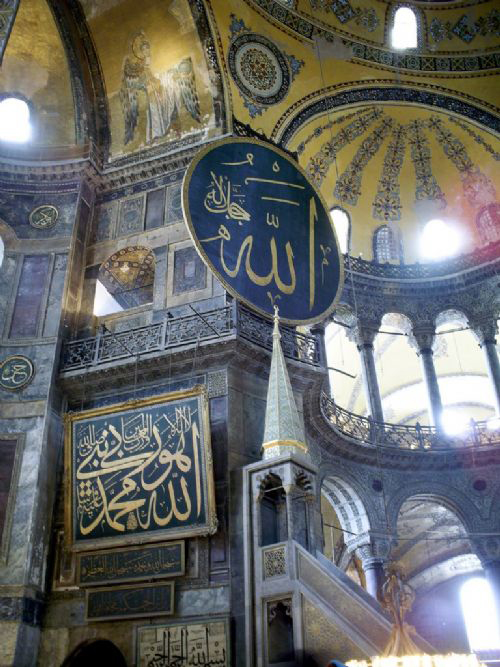
Restoration of the Santa Sofía
Though there are always exceptions, lovers of Istanbul could generally be divided into those whose tastes lean towards the Blue Mosque, and those who, if pressed, would have to choose Santa Sofia instead – just as in the times of Hippodrome, it would have been equally difficult to sit on the fence between the green and blue factions. There are few places quite like Istanbul and Bosforo, with their seductive aromas of the Orient – to use an old proverb. Despite it´s conversion to a mosque in 1453, despite the four magnificent minarets flanking it today, despite the stunning caligraphy under the seductive name of Allah and the eight prophets of the immense medallions suspended in the interior, despite the fact that the crusaders plundered the temple, taking to the Sainte Chapelle in Paris the gold from the mosaics, the crown of thorns of the Nazareth – Santa Sofia will always remain in the Western imagination as the most powerful example of the extraordinary wonder of the Byzantine Empire. Emperor (between 527-565) Justiniano, in the attempt to strengthen his public image, not only communicated with God in a sophisticated courtly ritual which ended up being adopted by the Greek Orthodox church, but, wishing to be the central point for all politics, as well as religion, he also constructed a grand imperial palace, and a church – the Santa Sofia of Constantinople. The Santa Sofia promoted a close identification between Christ and the emperor, who saw himself as his representative. The emperor had an unusual, bold approach to architecture – the combination of basilica columns, a central, circular-shaped building, the... read more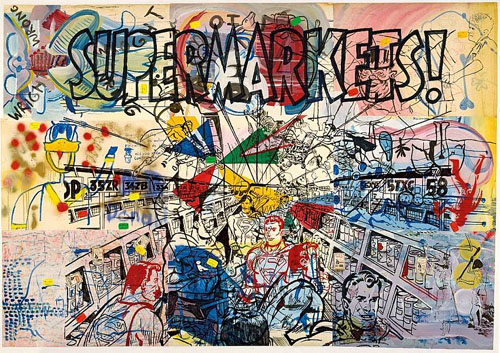
Tribute to Sigmar Polke
The Akademie der Kunst in Berlin opened a fantastic exhibition presents some of the most iconic designs of artist Sigmar Polke Jan. 14. Klaus Staeck, a close friend of Polke, pays tribute to more than 40 years of creative friendship between him and one of the most important German painters in this personal exhibition at the Academy of Fine Arts in Berlin. Staeck was not only editor and gallery owner of the famous painter, but also a creative partner. Now 90 large-format drawings are presented us, which Polke devised during more than 40 year of career before his death in 2010. He died prematurely at the early age of 69; one of the most international artists from Germany, which emphasized not only for its bold criticism, but also for his elegant sense of humor. Polke was born in northern Germany; he was a multifaceted artist who worked outside the traditional aesthetic parameters and academics. In the 60´s he became known as one of the founders of “Capitalist Realism”. With humor and critical distance watching our reality marked by a rapacious capitalism. The architect detected with insight empty political slogans and the dark temptations that lay in the depths of repression and bourgeois society. Without doubt, Polke was becouse of this one of the most interesting German artists, as he was able to bring out the ethical contradictions in our postmodern society. More info: http://www.adk.de/ Heloise Battista If you want to attend one of the most moving exhibits and, in turn, highlighted of the year, join a tour of the Akademie der Kunst in Berlin, and be inspired by the... read more
RANKINGS
Do you want to know the best cities to escape for gastronomy? We will tell you!

VERSUS
Showdown: pure and simple. Comparison is the best way to make a decision.

TRAVEL TIPS
Travelling means many things. We will provide you with all you need. Don’t miss anything.

APPS AND BOOKS
Technology and literature, the necessities of a good traveler.

GUEST
We want to hear your story; we want to travel with you.
Changes, progress and achievements. Only-apartments daily.
Promotions