English
 Français
 Deutsch
 Italiano
 Español


ONLY BE AMSTERDAMMER

ONLY BE BUDAPESTER

ONLY BE VENETIAN

ONLY BE BARCELONIAN

ONLY BE BERLINER

ONLY BE VALENCIAN

ONLY BE ISTANBULITE

ONLY BE FLORENTINE

ONLY BE LISBOETA

ONLY BE LONDONER

ONLY BE NEW YORKER

ONLY BE MADRILENIAN

ONLY BE MALAGUEÑO

ONLY BE MILANESE

ONLY BE PARISIAN

ONLY BE PORTUENSE

ONLY BE PRAGUER

ONLY BE ROMAN

ONLY BE SEVILLIAN

ONLY BE PROXIMAMENTE

ONLY BE ATHENIAN
ONLY BE COMING SOON
ONLY BE COMING SOON
ONLY BE COMING SOON
Last posts
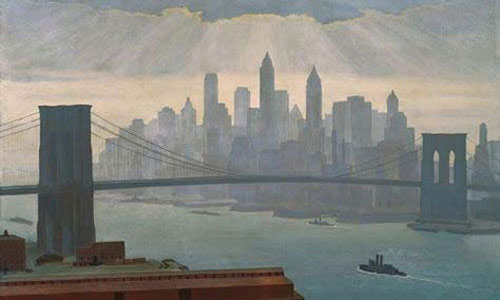
Exhibit from the Phillips Collection in Madrid: Made in the USA
It is not easy to find many characters as dynamic, multifaceted and influential as Duncan Phillips (1886-1966) in the history of American modern art. Referential art critic and collector, Phillips was also the founder and director of The Phillips Collection, based in Washington, which was the first museum of modern art in the United States opening 10 years before the MOMA in New York, did not open its doors until late 1929. From the day the museum opened in 1921, Phillips did not cease expanding. The collection, consisting mostly of works by modern artists, was based on what appealed to his penetrating critical eye. Hence, it constitutes an excellent, extensive and gloriously personal overview of art from the United States from the mid-nineteenth century to the sixties of the twentieth century. Now, the Mapfre Foundation in Madrid (Paseo de Recoletos, 23) will present selections from the collection until January 16, 2011 under the name Made in USA, the first exhibition organized by the Phillips Collection in Europe. It is a unique opportunity to approach a series of extraordinary artists who usually do not enjoy much representation in European museums. Particularly those working prior to World War II are often given short shrift, although after the conclusion of the war the United States became much more prominent in artistic matters. New York replaced Paris as the world art capital and American artists and critics began to dictate the major trends in a process that has only begun to shift back in recent years. The itinerary of the exhibition is divided into ten thematic areas, detailed below, chronologically covering 100 years... read more
Masaccio´s Trinity in Florence
By all accounts, the Chapel of the Holy Sepulchre in Jerusalem was built in the exact spot where the cross on which Jesus of Nazareth was crucified stood. According to tradition this is where Adam was buried. There is a fresco in Florence whose iconography shows the unusual combination of a Trinity, with which all of its death and decay, could well be a transposition of the sacred shrine. In it, God the Father solemnly oversees the martyrdom of his son from behind the cross, at the foot of which, flanking it, are Mary, whose eyes seem lost in the empty space, and Saint John. The three, Christ, Mary and Saint John, form a triangle whose base is widened by the figures beneath, the principals who commissioned the painting. A skeleton lying on a sarcophagus, inscribed with the memento mori ” I once was what you are and what I am you also will be” occupies the bottom of the fresco. This is the fresco of the Trinity, and was painted around 1425-28 by Masaccio, who died prematurely, poisoned before the age of 30 years. It occupies a space in one of the side walls of the church of Santa Maria Novella, famous above all for the unique polychrome marble facade by Leon Battista Alberti. Santa Maria Novella seems to offer a perfect example of the principles outlined by Alberti´s treatise on architecture exhibiting harmonic drive, and forming a whole in which all parties bear a relationship to each other as is the best music, so balanced that any alteration of any of the aspects would ruin the whole.... read more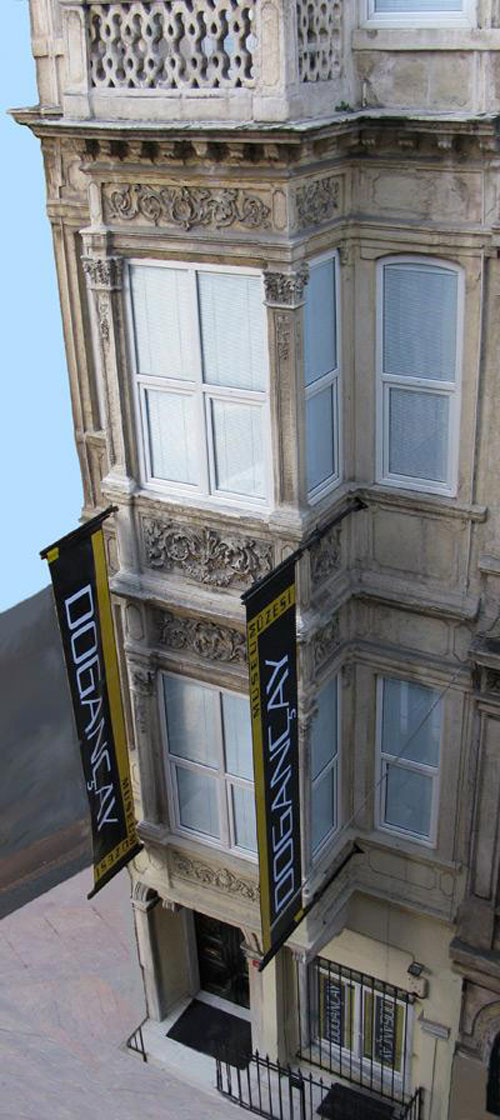
Dogançay Museum in Istanbul
Enrique Vila-Matas illustrates in one of his books a Chinese tale as told by Italo Calvino, about the very skilled artist Chuang Tzu, who was required by the emperor to draw a crab. Chuang Tzu took five years and a house with twelve servants as a necessary condition for the order. Apparently this was not sufficient, when he met the deadline he had not yet undertaken the task. Tzu Chang asked for another 1824 days, and they were granted. Then he drew the most perfect of crabs. In a prose poem by José Angel Valente, the painter and the king are one person, Hui-Tsung, a Chinese emperor who paints “with the skill of an expert in the contemplation of nature,” a quail and a daffodil in the corners as neither a ” a bird or flower can be a center, they are merely a guide for the eye that looks to find the essence of a bird and flower inscribed” With respect to Istanbul, we know thanks to Kemal Bey, a character in one of Orhan Pamuk´s novels, that during the fifties and sixties there was not a single museum where you could see pictures in Istanbul. Fans of painting used to make do with black and white photographs of birds, which they would meticulously illustrate and paint over or use them as models. The photographs could also be of other things, but birds became one of the favorite subjects in Istanbul. They applied their strokes slowly and patiently, with scrupulous attention to detail that, in the eyes of the author of this article, “has some connection to the... read more
RANKINGS
Do you want to know the best cities to escape for gastronomy? We will tell you!

VERSUS
Showdown: pure and simple. Comparison is the best way to make a decision.

TRAVEL TIPS
Travelling means many things. We will provide you with all you need. Don’t miss anything.

APPS AND BOOKS
Technology and literature, the necessities of a good traveler.

GUEST
We want to hear your story; we want to travel with you.
Changes, progress and achievements. Only-apartments daily.
Promotions